
A dead battery in a Camps Bay parking garage at 6 pm on a Friday is not a mechanical mystery. It is a predictable failure that becomes an emergency because the driver has somewhere to be and no way to get there. Most Cape Town car owners will recognise this scenario, or one like it: the grinding brakes on the commute down the N2, the check engine light that appears the morning of a road trip to the Garden Route, the suspension knock that develops after months of navigating the city’s pockmarked side streets. These are not exotic failures. They are the routine cost of operating a vehicle in a coastal city with temperature swings, stop-start traffic, and roads that punish undercarriages. Drivers now have more options for fixing them.
When Your Car Refuses to Start
The electrical system is where most owners first encounter helplessness. A lead-acid battery typically lasts three to five years, though Cape Town’s summer heat and winter damp can compress that window. Frequent short trips around the City Bowl or Atlantic Seaboard never let the alternator fully recharge the battery, accelerating the decline. When voltage drops below 12.0 with the engine off, the starter motor cannot draw enough current, and the result is silence or that single, defeated click.
Alternator failure presents differently. The battery warning light illuminates, headlights dim at idle, and eventually the engine stalls because the charging system cannot sustain ignition and electrical loads simultaneously. A healthy alternator produces 13.5 to 14.5 volts when running; anything below that range signals replacement.
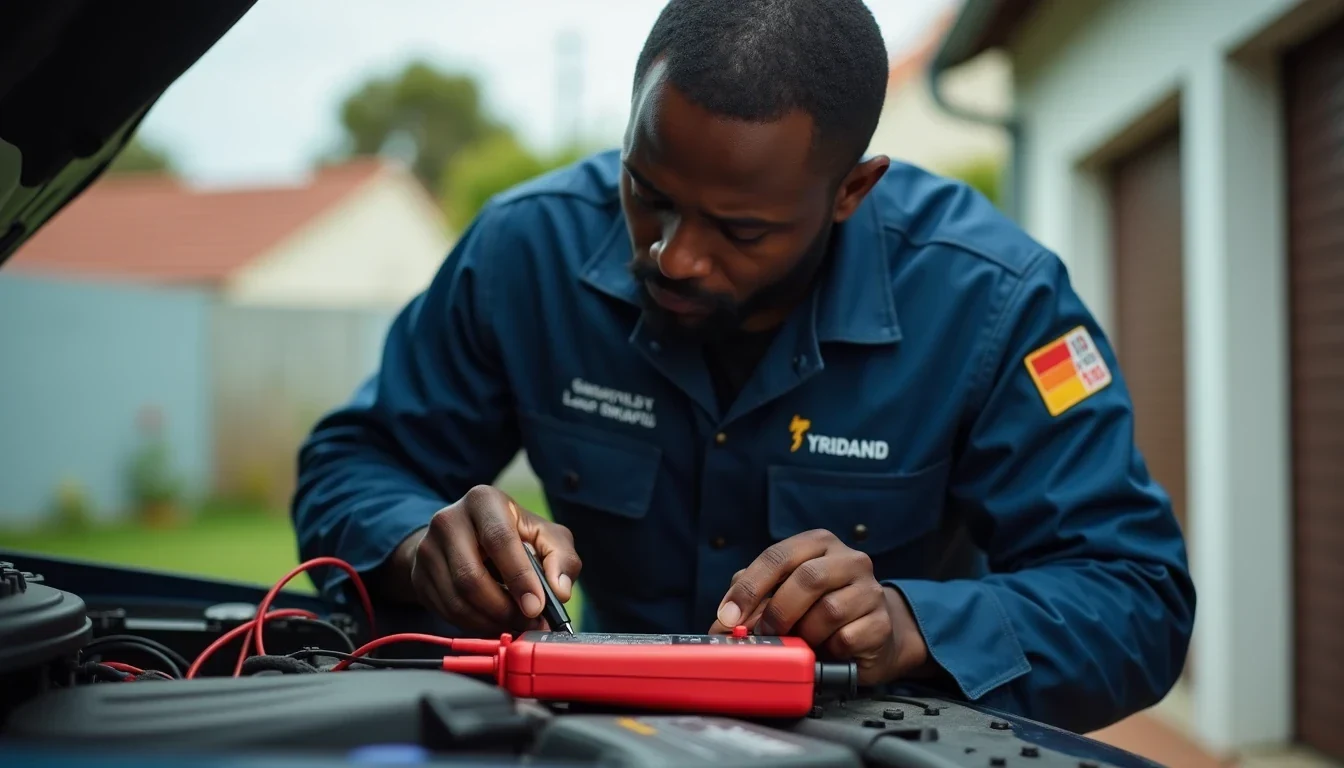
Starter motors draw 100 to 200 amps to crank the engine. Worn solenoids, damaged drive gears, or burnt windings produce the classic symptom: power everywhere else, but no rotation. Parasitic drains from aftermarket alarms or accessories can also flatten a healthy battery overnight. Corroded terminals, common in coastal air, restrict current flow and mimic more expensive failures. A mobile mechanic with a multimeter and load tester can isolate the actual cause in minutes, at your home or office, without the diagnostic fee a workshop tacks on just to look.
Brakes, Suspension, and What You Feel Through the Pedal
Brake pad wear announces itself. Manufacturers integrate metal wear indicators that squeal when friction material thins to 3 millimetres or less. Ignoring this causes the backing plate to grind against the rotor, extending stopping distances by 20 percent or more and multiplying repair costs. Warped rotors, caused by heat cycling and uneven cooling, transmit vibration through the steering wheel under braking. This indicates reduced contact patch and inconsistent deceleration.
Suspension degradation is easier to miss because it happens gradually. Worn shocks or struts allow excessive bounce after bumps, nose-diving under braking, and body roll through corners. The bounce test is crude but effective: press down hard on a corner and release. More than two or three oscillations means the dampers are finished. Poor damping accelerates tire wear and reduces the tire’s contact with the road surface exactly when you need it.
Tire condition reveals alignment and inflation sins. Wear concentrated on both edges indicates underinflation. Centre wear means overinflation. Single-edge wear points to camber misalignment or worn control arm bushings. South African law mandates 1.6 millimetres of tread depth across the central three-quarters of the tire width, but performance degrades well before that legal minimum. A mobile mechanic performing a pre-trip inspection at your driveway can catch these patterns before they become blowouts on the N1.
Engine Warnings You Should Not Clear and Ignore
The check engine light is not a suggestion. A steady illumination indicates a fault stored in the OBD-II system, ranging from a loose fuel cap (tighten it, drive three cycles, and the light may extinguish) to a failing oxygen sensor that can reduce fuel economy by up to 40 percent and damage the catalytic converter. A flashing check engine light demands immediate attention because it signals active misfire that will destroy the catalytic converter within kilometres.
Overheating in Cape Town traffic is particularly destructive because modern aluminum cylinder heads warp quickly above 95 degrees Celsius. Causes include coolant leaks from perished radiator hoses, stuck thermostats, or failed water pumps. Steam from under the bonnet is an instruction to stop before the head gasket becomes a four-figure repair.
Misfires from worn spark plugs, faulty ignition coils, or clogged injectors produce rough idle, hesitation under load, and increased fuel consumption. Copper plugs may need replacement at 30,000 kilometres; iridium designs often reach 100,000. A mobile mechanic with a code reader and basic tooling can diagnose these faults where the car sits, eliminating the temptation to “see if it clears itself” while driving to a workshop appointment next week.
The Workshop Alternative That Comes to You
Traditional garages have their place for major rebuilds and bodywork. For the common faults described above, mobile mechanics offer a different value proposition rooted in structural economics. Without the rent, rates, and utility burden of a fixed premises, mobile operators typically charge 10 to 30 percent less per labour hour than Cape Town workshops quoting R500 to R800 hourly rates. The mechanic who quotes the work performs it, eliminating the service adviser layer where miscommunication and upselling occur.
Transparency operates differently when the repair happens in your driveway. A mobile mechanic can show you the 2-millimetre brake pad, the cracked coolant hose, the corroded terminal. Some photograph faults for customer records. This is practical verification that the quoted work corresponds to actual wear. Direct communication also means you source your own parts if you prefer, though warranty considerations vary.
The emergency value is harder to quantify but more immediately felt. A non-starting vehicle at a shopping centre or office park requires either a tow (R800 to R2,000 in metropolitan Cape Town, plus waiting time) or a mobile technician who arrives with a battery tester, jump pack, and replacement stock. Overheating on the M5 during evening rush, a serpentine belt failure on a weekend away, a flat tire with no spare: these situations resolve faster when the mechanic travels to the vehicle rather than the reverse.
Scheduling That Matches Real Life
Even non-urgent repairs benefit from temporal flexibility. Mobile mechanics routinely book evenings and weekends, times when workshops are closed or charge premium rates. The driver can work from home, collect children, or manage household tasks while the service proceeds in the driveway. There is no arranging alternate transport, no shuttle service, no second trip to collect the vehicle. For dual-income households or single parents, this time recovery often exceeds the direct cost savings.
The intimidation factor of traditional garages, frequently discussed in consumer forums, deserves mention. Some owners, particularly those with limited mechanical knowledge, report pressure to authorise additional work, unclear explanations, or difficulty questioning diagnoses. A mobile service in your own space, with the mechanic explaining directly to the person who drives the car, reduces this friction. The power dynamic shifts when you are on your own property and can pause, verify, or decline without the social pressure of a service desk queue.
Making the Choice for Common Faults
Not every repair suits mobile service. Major engine rebuilds, transmission overhauls, and bodywork require lifts, specialised tooling, and controlled environments. But the failures that strand Cape Town drivers most often, batteries, alternators, brake pads, suspension components, cooling system leaks, and diagnostic work, are precisely the jobs a equipped mobile technician handles efficiently.
The decision framework is straightforward. For faults that immobilise the vehicle or create safety risk, mobile response eliminates towing cost and delay. For maintenance items with predictable wear, mobile scheduling recovers personal time. For any repair where you want to observe, question, or verify the work, mobile service provides visibility that workshop bays cannot replicate.
The city’s driving conditions will continue to produce these failures. Batteries will age in coastal air. Brake pads will thin on the descents from Table Mountain. Suspension components will absorb punishment from roads that never quite smooth out. What has changed is whether addressing them requires surrendering your vehicle, your schedule, and your afternoon to a workshop queue, or whether the solution travels to where you already are.