Cape Town’s winter rain quickly exposes tired tires. A tread depth that passes a casual glance can still leave the car skating across standing water, especially when the road is cold, slick, and busy. The legal minimum is one millimeter, but that is a floor for roadworthiness, not a sensible target for wet-weather driving.
A tire can still look presentable even when useful grip has already dropped away. The outer face may seem fine from five steps back, but the inner shoulder tells a very different story once the wheel is turned or the car is lifted. This wear often catches people out, because the tire does not have to look bald to be unsafe.
1 mm is a legal floor, not a safe wet-road target
South African road rules require at least 1 mm of tread across the tire’s full width. Once the tread wears down to the built-in wear bars, the tire is finished for practical purposes and should be treated as unroadworthy. Those bars show where the tire has reached the end of useful life; they do not encourage you to squeeze a few more months out of it.
Wet roads change the equation completely. Tread cuts through water, moves it out of the contact patch, and keeps rubber on asphalt. In Cape Town’s winter rain, that function becomes important long before the tire is bald. A tire with shallow tread can still pass the legal test and still be poor at clearing water when the M3 or the N2 is covered in spray, puddles, and brake dust.
The Road Traffic Management Corporation has repeatedly pointed to tire failure as a major factor in vehicle crashes. This aligns with real-life observations. Tires rarely fail in a dramatic, neat way. More often they become weak, noisy, uneven, and underperforming. Someone discovers the problem only after a scare on a wet bend or during a hard stop.
If your thinking stops at 1 mm, you are measuring legality. If your thinking stops at how the tire feels in dry weather, you are missing the part that matters in winter.
The tyre can look fine and still be finished
The easy mistake is checking the outer face of the tire, seeing visible grooves, and assuming the job is done. It is not. Wear does not spread itself evenly across the whole tire, and the part that gets missed most often is the inner shoulder. That section can be worn through while the outside edge still looks healthy enough to fool the eye.
A tire run low on pressure often wears both shoulders faster. A tire with too much pressure tends to wear the center first. Alignment problems usually leave a one-sided pattern, where one edge does more work than the rest. None of that shows up properly if you only stand beside the car and glance at the tread.
Look for these warning signs:
- The center is worn flatter than the edges
- Both shoulders are disappearing faster than the middle
- One inside edge is much thinner than the rest
- The tread has a saw-tooth or feathered feel when you run a hand across it
- The sidewall is starting to crack
- The tire has aged to the point where the rubber looks tired and dry
Age matters even when the tread depth still looks acceptable. Rubber hardens over time. A tire that still has grooves left can have less bite than you expect if it has spent years baking in the sun, sitting under a car cover, or running with the wrong pressure.
You also need to keep an eye out for damage from potholes and curbs. A bulge on the sidewall is a serious warning sign. So is a cut, a blister, or a patch of rubber that looks distorted. Those faults are not cosmetic. They point to internal damage that can turn into a sudden failure.
Check all four tyres properly
A proper tire inspection is not a quick circle around the car. Measure all four tires, then measure each tire in more than one place. The shallowest reading is the one that counts, not the nicest number you happened to find on the outer edge.
Use a tread depth gauge if you have one. If you do not, get someone who does. A coin test tells you almost nothing useful when you are trying to decide whether a tire is still safe in winter rain. The actual depth matters, not a rough guess.
A sound inspection looks like this: 1. Check the outer shoulder, center, and inner shoulder of each tire 2. Turn the steering wheel fully to expose the front inner shoulders 3. Inspect the rear tires from a better angle, or ask for the car to be lifted 4. Check both left and right sides, not just one tire per axle 5. Record the lowest measurement for each tire
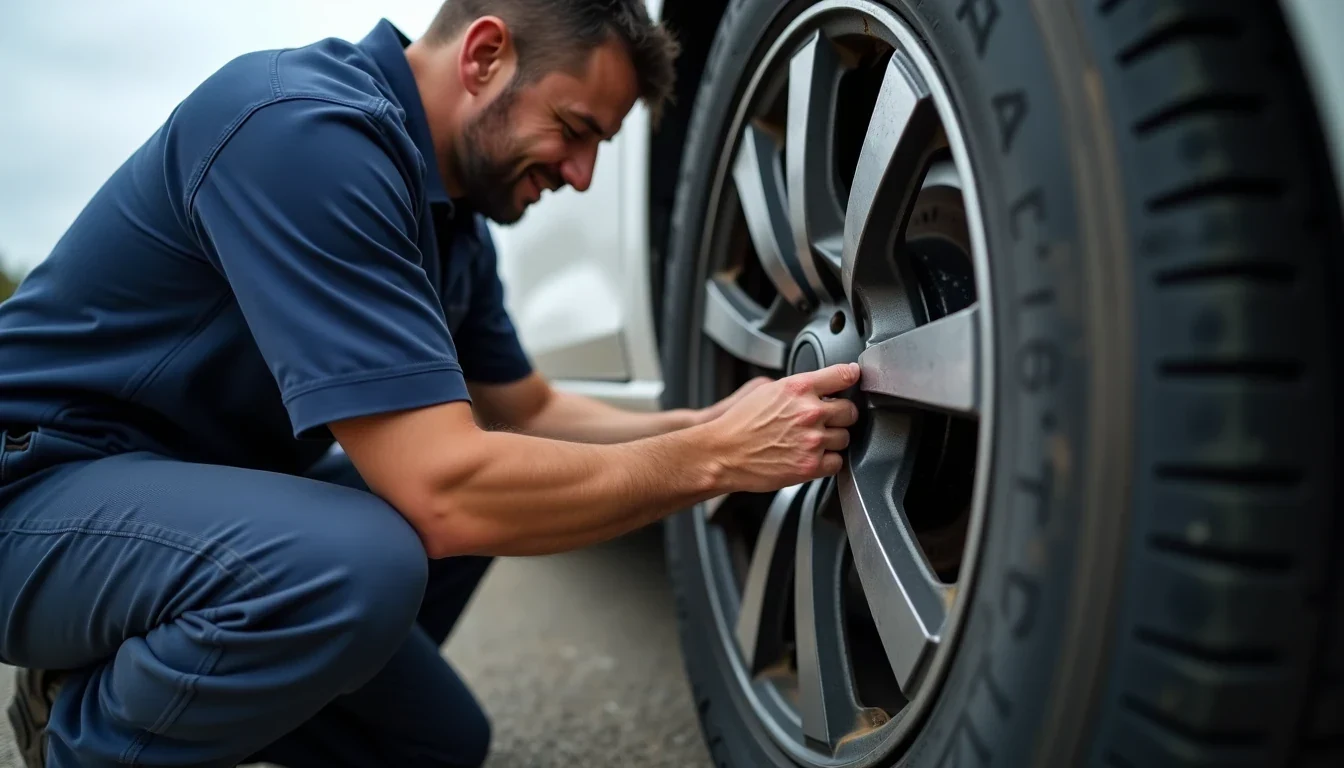
Turning the steering wheel helps on the front tires because the inner shoulder is usually the hardest part to see from standing height. On some cars, you still will not get a proper view without lifting the vehicle. A mobile mechanic can inspect the tire properly, get under the car if needed, and spot wear that would otherwise stay hidden.
A tire can still look roadworthy from the outside and be badly worn on the inside edge. This is especially common on cars that spend their lives doing short trips, climbing hills, or hammering over rough city roads with one or two tires carrying the wrong pressure for months.
Pressure and alignment usually leave the first clues
Tire wear is often a symptom, not the main problem. If the tires are wearing in a strange pattern, the car is usually telling you something about pressure, alignment, or suspension. Ignoring that message just means the next set of tires will suffer the same fate.
Wrong pressure is the simplest cause and the easiest to miss. Underinflation lets the tire flex too much, heats it up, and scrubs the shoulders away. Overinflation reduces the contact patch and wears the middle faster. Both faults hurt grip, especially in the wet, because the tire is no longer sitting on the road as it should.
Uneven wear can also point to alignment trouble. If the steering pulls to one side, or the tire on one corner keeps wearing more quickly than the rest, the wheels may not be pointing where they should. Suspension wear can do the same thing. Worn bushes, shocks, or ball joints can leave the tire doing odd work every time you brake or turn.
Cracks matter too. Small cracks in the sidewall or between tread blocks usually mean the rubber is aging or drying out. The tire may not fail immediately, which is part of the problem. People see no immediate drama and assume the tire is fine, then continue driving on something that has already started to break down.
When a mobile mechanic is the sensible call
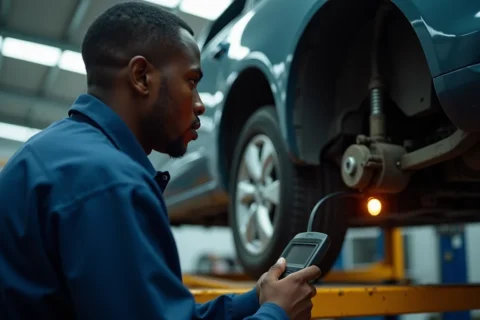
If you are not getting a clear picture from a driveway inspection, bring in someone who can do it properly at home or at work. A mobile mechanic can check tread depth, pressure, wear patterns, sidewall damage, and age without you having to book the car into a workshop and sit around waiting for a slot.
This is especially useful when the tire issue is tied to a wider fault. One worn inner shoulder might mean one wheel alignment problem. Two worn shoulders across an axle might point to incorrect pressure. Cracking plus age plus a hard ride can mean the tire is simply done. Sorting the cause early saves money, because you are not just replacing rubber; you are stopping the next set from wearing out the same way.
If you are checking tire age, look for the DOT code on the sidewall. It is a four-digit date stamp. The last two digits show the year, and the first two show the week. A tire with plenty of tread but a long service life behind it deserves a closer look, because time and sunlight damage rubber even when the car is not doing many kilometers.
The safe habit is simple. Check tread, check the shoulders, check pressure, check for cracks, check for uneven wear, and check the age. If any one of those looks suspect, do not wait for the next heavy rain to prove the point.